
By Ricky Skids – Skidded Media
So you want to buy a used car. Maybe it’s that questionable Facebook Marketplace listing with blurry photos taken on a Motorola from 2008… or maybe it’s a used car dealer who looks like they stepped straight out of Grand Theft Auto IV. Either way, the mission is the same:
How do you make sure you’re buying a good car—and not a financial trap with wheels?
After years of fixing, modifying, flipping, and inspecting hundreds of cars (both personally and through my former dealership), I’ve learned exactly what to look for. Today, I’m breaking down the entire process so you can walk into any used-car situation with confidence.
Let’s make sure you get the right car and avoid the scams.
—
Meet the Example Car: My ‘97 Miata STO
For this guide, I’m using my 1997 Mazda Miata STO—a car I recently picked up and have already done several fixes on. It needs paint, but it runs, drives, and is perfect as a demonstration model.
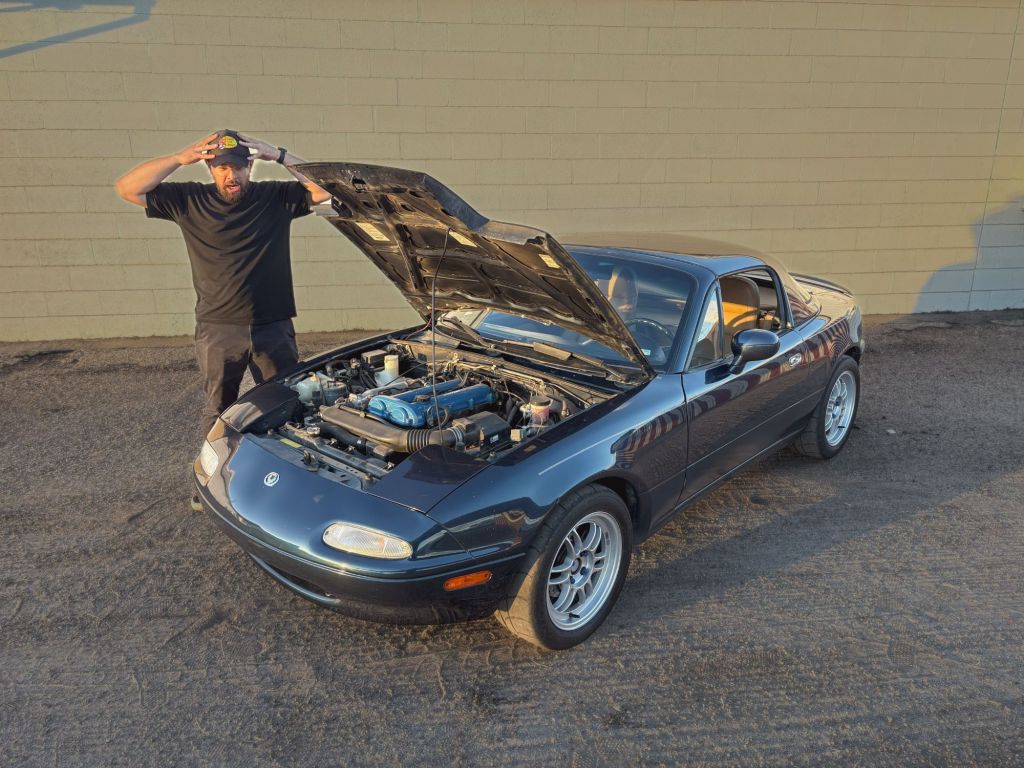
If you’re wondering how I know all this—well, years in the enthusiast world plus running a car dealership will do that. My business partner and I regularly attended dealer-only auctions with 400 to 2,500 cars available at a time. You learn very quickly how to spot problems—and how to spot the cars that’ll leave you stranded on the side of the freeway.
Not everything was sunshine and rainbows. We got screwed a few times too. And that’s exactly why I’m making this guide.
—
Step 1: Walk Around the Car
This is where most major red flags show up. You’re looking for wrecks, bad repairs, rust, and anything that indicates the seller isn’t telling you the full story.
Check the Body Lines
Cars are symmetrical. Like a butterfly, both sides should mirror each other.
Look for:
Uneven gaps between fenders, hood, doors, or bumpers
Panels that sit too high or too low
Misaligned headlights or tail lights
Misaligned gaps = strong chance the car’s been in a wreck.
Check the Paint
My Miata still has its oxidized factory paint, but here’s how to spot a repaint:
1. Color mismatch
Metallics and pearls especially are almost impossible to match unless it was a high-quality job. Look at it in direct sunlight—never in the dark or when it’s raining.
2. Overspray
Paint where paint shouldn’t be:
Wheel wells
Weather seals
Rubber gaskets
Chrome trim
Even glass
If you see overspray, someone cut corners.
3. Door jambs, underhood, trunk
If the car used to be red and is now white… the jambs will snitch on the previous owner.
4. Orange peel
A wavy, bumpy clearcoat texture (like an orange skin). It’s common on cheap paint jobs.
Orange peel can be corrected with wetsanding and buffing—but cheap clearcoat will fade and fail quickly.
—
Bonus: Small Clues About How the Car Was Treated
Tires:
Tires tell a story.
Good signs:
Matching brand tires
Name-brand (Michelin, BFG, Continental, etc.)
Even tread wear
Bad signs:
Four mismatched cheap tires
Uneven wear
Bald shoulders or cupping
I worked at Discount Tire—trust me, tires reveal who cared about their car and who didn’t.
Brakes:
Visible grooves or a ridge on the rotors = they ran the pads too long. Not expensive to fix, but it shows the owner neglected routine maintenance.
Suspension:
Bounce test
Push down hard on the bumper. If it bounces more than once, the shocks are worn out.
Side shove test
Push the car side-to-side. Listen for:
Clunks
Pops
Creaks
Could be worn bushings, ball joints, sway bar links, etc.
—
Step 2: Look Underneath
Get low. Yes, even if you’re in nice clothes.
Check for:
Oil leaks
Coolant leaks
Transmission leaks
Power steering leaks
Rust (especially structural)
Scrapes on the subframe or oil pan
If it looks like someone used the underbody as a skateboard rail, that’s a bad sign.
—
Step 3: Pop the Hood
Before opening the radiator cap, make sure the engine is cool. Touch it with the back of your hand—if it’s hot, don’t open it unless you enjoy second-degree burns.
Once it’s safe, check:
Oil
Pull the dipstick:
Low oil = neglect
Jet-black oil = late changes
Thick sludge under the oil cap = walk away
Coolant
Should be:
Clean
Green, pink, or orange depending on type
Brown sludge or “milkshake” coolant = possible blown head gasket.
Transmission Fluid (automatics)
Healthy: bright red/pink
Bad: dark brown, burnt smell
Other fluids
Check brake, clutch, and power steering fluids. Dirty but full is okay—burnt or contaminated is not.
Belts, Hoses & Wiring
You’re looking for:
Cracked hoses
Torn vacuum lines
Melted connectors
Dollar-store electrical tape “repairs”
A serpentine belt with cracks or chunks missing
If the car has a timing belt, verify when it was last replaced. On interference engines, a failed timing belt can destroy the engine.
Start the Engine
Listen for:
Knocking
Squealing
Ticking beyond normal injector noise
Rough idle
If you have an OBD2 scanner, use it. Check for:
Current codes
Pending codes
Freeze-frame data
Past/hidden codes
This can reveal problems the seller cleared right before you showed up.
—
Step 4: Inspect the Interior
Test everything:
A/C
Heat
Windows
Locks
Mirrors
Radio
Horn
Wipers
All lights
A/C Test
Compressor should click on
Cold air should come out
If it’s slightly cool: likely low refrigerant
If it’s not cool at all and there’s no compressor click: bad compressor or clutch
Heat Test
No heat = clogged heater core (expensive) or climate control issues.
—
Step 5: The Test Drive
Turn the radio off—no distractions. You want to hear everything.
Engine
Smooth acceleration. No hesitation. No misfires.
Transmission
Manual: no grinding, smooth engagement
Automatic: no harsh shifts
CVT: no lag or shuddering (especially on Nissans…)
Steering & Alignment
On a flat road, lightly loosen your grip:
If the car drifts hard to one side → alignment, tire pressure, or suspension issue
Braking
Brake hard (safely):
If it pulls left/right → brake or alignment issues
Highway Test
Get up to 65–75 mph. Watch for:
Vibrations
Steering wander
Overheating
Transmission slipping
This is where hidden issues reveal themselves.
—
Final Thoughts: Did You Find a Good Car?
If the car passes everything above, you’ve likely found a solid vehicle. These are the exact steps I’ve used for years—at auctions, dealerships, and private sales.
A few last tips:
Always check the Carfax if available
If possible, get a pre-purchase inspection from a trusted shop
Expect some imperfections—no used car is perfect
Even with all this, there’s always a chance of getting a lemon. But if you follow this guide, you’ll avoid 95% of the traps people fall into—and save yourself thousands in the long run.
Thanks for reading. If you found this helpful, share it, save it, and follow Skidded Media for more enthusiast-driven automotive content.
Stay sick tight.
— Ricky Skids
 Skidded Media
Leave a comment